 Business License

Glass Oil Dispensers Are Having a Moment — What B2B Buyers Need to Know
We used to think oil dispensers were boring. A bottle with a spout — what's there to get excited about?
Then we started paying attention to what was happening in kitchens. Not industrial kitchens — home kitchens. People were buying olive oil in glass bottles with sleek spouts. They were leaving them on countertops like decor. They were talking about drip-free pour, UV protection, and how a good dispenser changed the way they cooked.
We started asking questions. Why this sudden interest? Why now?
What we found surprised us. The global oil dispenser bottle market was valued at USD 2.39 billion in 2025 and is projected to reach USD 3.27 billion by 2031, growing at a CAGR of 5.36%. These bottles, once limited to restaurant use, have found a stronghold in both residential and professional settings. Glass bottles, in particular, are preferred for their inertness and visual appeal.
For B2B buyers — importers, wholesalers, hospitality suppliers — this is a category that's quietly exploding. And the suppliers who understand what's driving it are the ones winning the contracts.
In our comprehensive guide on How Glassware Is Packed and Shipped Safely Around the World, we cover the full spectrum of glassware logistics. This article zooms in on one specific product category: glass oil dispensers, and what importers need to know to source them right.
Why Oil Dispensers Are Suddenly Everywhere
Walk through any kitchenware section these days and you'll see oil dispensers. They're on restaurant tables, in home kitchens, in gourmet gift sets. We've identified four key drivers behind this trend.
Health consciousness. Consumers are more aware of how much oil they use. Dispensers with precise pouring and portion control let people moderate their intake. Olive oil, avocado oil, and specialty infused oils are now valued as premium ingredients, not just cooking mediums.
Sustainability. There's a strong consumer backlash against single-use plastics. Glass dispensers designed for refilling and long-term use are gaining popularity over disposable plastic containers. Major packaging firms are ramping up recycled content — Verallia reported a 56.7% external cullet usage rate in 2024.
The rise of home cooking. Global olive oil consumption is forecast to hit 3,064,500 tonnes in the 2024/25 crop year. As home cooks adopt professional techniques, they want professional tools — including precise dispensing instruments.
Aesthetics. Modern kitchen designs emphasize minimalism and uniformity. A sleek glass dispenser isn't just functional — it's decor.
The trend toward "elevated home cooking experiences" and "restaurant-quality tabletop presentation" has made oil dispensers a fundamental kitchen item. What was once a utilitarian object is now a statement piece.
Glass vs. Plastic: The Material Decision That Actually Matters
We've watched buyers agonize over this. Glass costs more upfront. Plastic is cheaper. But here's what our experience has taught us: in oil dispensers, glass is winning.
The European Container Glass Federation reported that sales of food and beverage glass containers totaled 76.5 billion units in 2024. That's the scale of the shift toward glass.
Glass is inert. It doesn't react with oil. It doesn't leach chemicals. It preserves freshness and protects against UV light — especially important for premium olive oils that degrade when exposed to light. And it looks better on a table.
For B2B buyers, the question isn't "glass or plastic?" It's "what kind of glass, and what kind of spout?"
Soda-lime glass is the standard for most oil dispensers — it's food-grade, oil-resistant, and cost-effective. Borosilicate glass offers higher heat resistance for dispensers that might be used near stovetops. Tinted glass (amber or green) provides UV protection for light-sensitive oils.
The real differentiator? The spout.
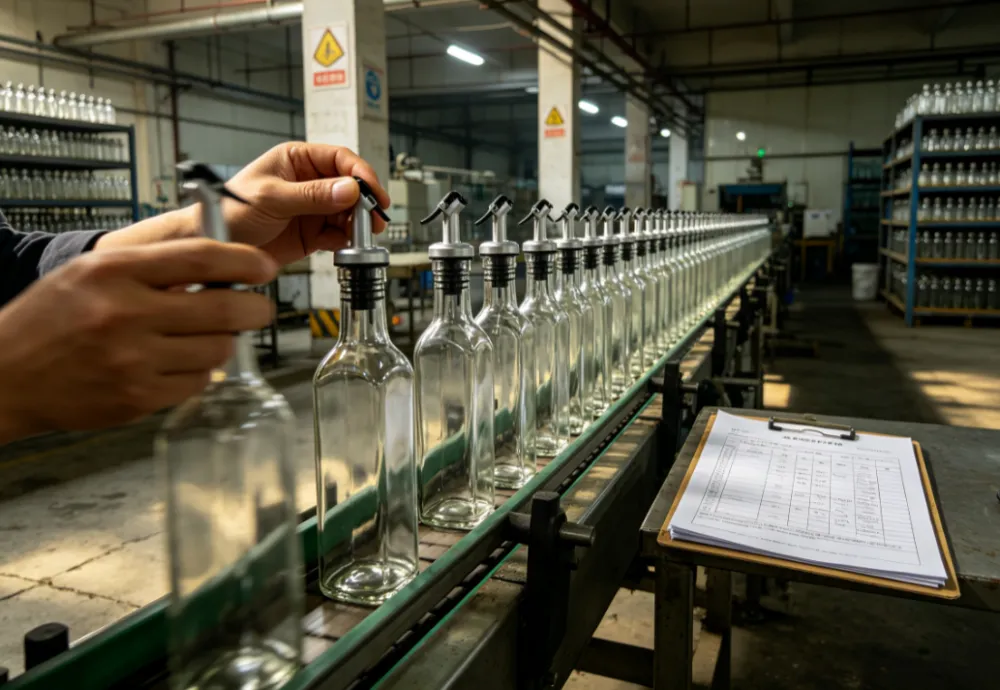
The Spout Is Everything (And Most Buyers Get This Wrong)
Here's what we've learned after watching too many importers focus on the bottle and ignore the spout.
A beautiful glass bottle with a cheap spout is a disaster. Oil drips. The neck gets greasy. Customers get frustrated. The product gets returned.
The best oil dispensers have spouts engineered with two key elements: a sharp cutoff that provides a clean break in the flow, and an air-return tube that allows air to enter the bottle as oil pours out. This creates a smooth, non-glugging stream and prevents the vacuum that causes drips. It's the difference between a product that works and a product that frustrates.
Stainless steel spouts are the gold standard — they're durable, food-safe, and don't corrode. Some feature hinged caps or silicone dust caps for extra protection. For hospitality buyers, lever-lock spouts offer controlled pouring and leak-proof storage, ideal for restaurant tables.
When you're evaluating suppliers, don't just look at the bottle. Test the spout. Pour oil. See if it drips. See if it glugs. This is where quality lives or dies.
The Compliance Question: FDA, LFGB, and What They Actually Mean
We've said this before, and we'll say it again: a supplier saying "we are FDA compliant" is not the same as providing a test report.
For oil dispensers, food safety is non-negotiable. Oils are acidic and can leach chemicals from poor-quality materials. Ensure suppliers hold food-grade certifications such as FDA (U.S.), LFGB (Germany), and ISO 6486 for glass leaching tests. ISO 6486 measures the migration of heavy metals from glass into food simulants — critical for food contact materials.
For spouts and caps, look for ANSI/NSF 51 certification, which evaluates material safety and impact resistance in commercial kitchen environments. For plastic components, REACH and RoHS compliance ensures absence of restricted substances.
The key difference? LFGB requires testing with specific food simulants — often more stringent than FDA. A product that passes LFGB is essentially guaranteed to pass FDA and most other global standards. But you need to see the actual test reports, not just a marketing line.
Where Your Supplier Is Located Matters
China remains the dominant manufacturing hub for oil dispensers — offering competitive pricing, advanced production capabilities, and vast supplier diversity. But not all regions are equal.
Guangdong Province excels in smart-designed dispensers with features like drip-free spouts, UV-protected bottles, and ergonomic handles. Proximity to Shenzhen and Guangzhou ports ensures fast global shipping.
Zhejiang and Jiangsu are renowned for high-quality glassware production, leveraging decades of craftsmanship to produce heat-resistant, lead-free, and chemically inert glass dispensers.
Shandong is a center for large-scale glass manufacturing, ideal for bulk orders requiring durability and consistent output.
Cities like Jinhua (Zhejiang), Xuzhou (Jiangsu), and Guangzhou (Guangdong) host dense industrial zones where material suppliers, mold makers, packaging providers, and testing labs operate in close proximity. This ecosystem enables end-to-end production, reduces lead times, and enhances cost control — making these locations ideal for B2B buyers seeking scalable partnerships.
At KINGSTAR GLASSWARE, we manufacture oil and vinegar bottles at our Qingdao factory, serving customers across different regions. We handle pourer assembly, flow testing, and carton reinforcement, and offer mixed container support for importers.
What Our Experience Has Taught Us
A few years ago, we worked with a European hospitality supplier who was sourcing oil dispensers for a chain of boutique hotels. They had a clear brief: the dispensers had to look elegant on the table, pour perfectly every time, and survive daily use in a busy restaurant environment.
They requested samples from five different factories. They tested every spout — pouring oil, vinegar, even water — to check for drips and glugs. They put the bottles through dishwasher cycles to see if the glass clouded or the spouts corroded. They checked certifications by contacting the issuing bodies directly.
The supplier they chose wasn't the cheapest — they were about 10% higher than the lowest quote. But their dispensers didn't drip. Their glass stayed clear. Their spouts didn't rust. And their breakage rate during shipping was under 1%.
That supplier was us. KINGSTAR GLASSWARE. The client has reordered four times in three years. They've expanded from oil dispensers to vinegar cruets, storage jars, and custom glassware for their hotel rooms.
That's the difference between treating supplier selection as a transaction and treating it as a partnership.

MOQ and Pricing: What to Expect
For standard oil dispenser bottles, MOQs typically start around 1,000 to 10,000 units depending on the supplier and customization level. Custom orders — custom shapes, colors, or branding — usually require higher MOQs.
Pricing varies widely based on volume, material, and spout type. For standard 250ml-500ml glass oil bottles with stainless steel spouts. Bamboo or cork lid options may command a slight premium.
For custom branding — logo etching, silk screening, or hot stamping — expect additional setup costs and higher MOQs.
The Checklist Every Importer Needs
Based on our years of experience evaluating glassware suppliers, here's our non-negotiable checklist for oil dispenser sourcing.
Material verification: Specify soda-lime or borosilicate glass in writing. Request material composition documentation. For premium olive oil, consider tinted glass for UV protection.
Spout quality: Test samples for drip-free performance. Look for sharp cutoff and air-return tube design. Stainless steel is the gold standard.
Compliance documentation: Request actual test reports — FDA, LFGB, ISO 6486 — from accredited labs. Don't accept generic certificates.
Sample testing: Request 5-10 fully assembled samples. Test pour accuracy, seal tightness, glass clarity, and overall build quality.
Factory audit: If possible, visit the factory or request a virtual walkthrough. Inspect production lines and quality control processes.
Performance metrics: Ask for on-time delivery rate, response time, and reorder rate data. A high reorder rate suggests consistency and service excellence.
Packaging specifications: Specify carton strength, dividers, and palletization requirements. Don't assume the supplier knows what you need.
Third-party audits: Engage firms like SGS or TÜV for independent quality verification.
What KINGSTAR GLASSWARE Does Differently
At KINGSTAR GLASSWARE, we've spent years refining our oil dispenser production — from 250ml tabletop bottles to 750ml kitchen standards, in both clear and tinted glass, with stainless steel, bamboo, or cork spout options.
We use food-grade glass that meets FDA and LFGB food-contact standards. Our spouts are engineered with sharp cutoff and air-return tubes for drip-free performance. We offer OEM/ODM customization with flexible MOQ, including custom sizes, colors, shapes, and branding. We provide factory-direct wholesale for kitchenware retailers, hospitality suppliers, and importers worldwide.
We've learned the hard way what works and what doesn't. And we've built our quality control around the simple belief that if it doesn't meet your specifications, it doesn't leave our factory.
For a complete overview of glassware packaging, sea freight logistics, and export logistics, read our comprehensive guide on How Glassware Is Packed and Shipped Safely Around the World.
Ready to source oil dispensers that actually work? Reach out to KINGSTAR GLASSWARE. Tell us your product, your volume, and your target market. We'll show you how we manufacture — and we'll back it up with real test results.
FAQ
What type of glass should oil dispensers be made of?
Soda-lime glass is the standard for most oil dispensers — it's food-grade, oil-resistant, and cost-effective. Borosilicate glass offers higher heat resistance for dispensers used near stovetops. For premium olive oils, tinted glass (amber or green) provides crucial UV protection that prevents oxidation and flavor degradation.
What certifications should I look for when sourcing oil dispensers?
Prioritize suppliers with FDA compliance for the US market and LFGB certification for European markets. Also look for ISO 6486 for glass leaching tests, ANSI/NSF 51 for material safety in commercial kitchens, and REACH/RoHS compliance for plastic components. Request actual test reports from accredited labs — not generic certificates.
What's a typical MOQ for glass oil dispensers, and how does it affect pricing?
Standard stock bottles typically have MOQs of 1,000 to 10,000 units. Customized products — custom shapes, colors, or branding — usually require higher MOQs. Lower MOQs are available at higher per-unit prices.
Recently Posted
-
Glass Water Bottle Sourcing Guide: What B2B Importers Need to Know
August 27, 2026The first time a retail buyer told me she was replacing her entire water bottle range, I assumed it was about price.It wasn't.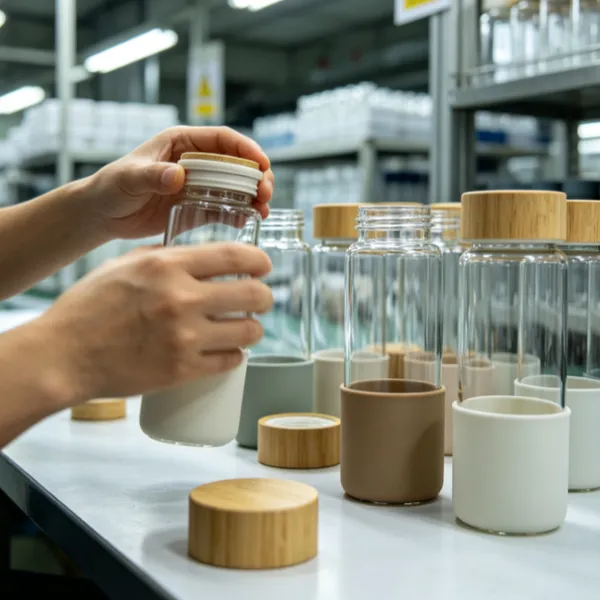 Read More
 -
How to Choose the Right Glass Spice Jar Supplier for Wholesale Orders
August 12, 2026The first time I watched an importer open a container of spice jars and find 15% of them cracked, I learned something that stuck w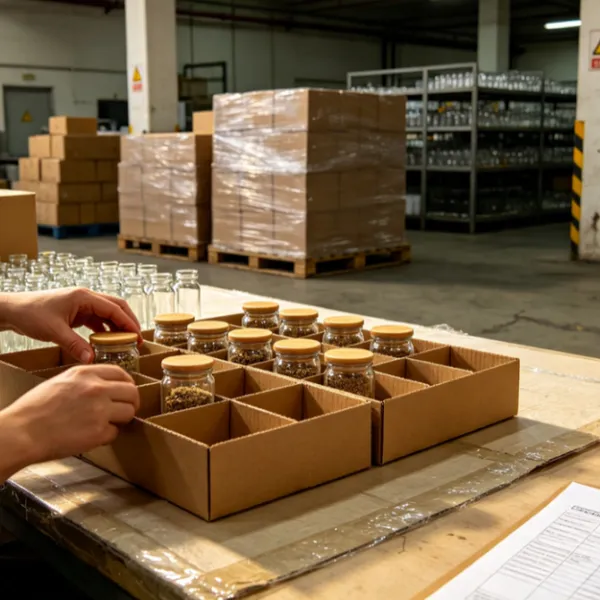 Read More
 -
Bamboo vs Metal vs Glass Lids for Wholesale Glass Jars
August 10, 2026(Key Takeaways)•Material Matters: The lid is just as important as the glass vessel itself when sourcing wholesale glass jars, dire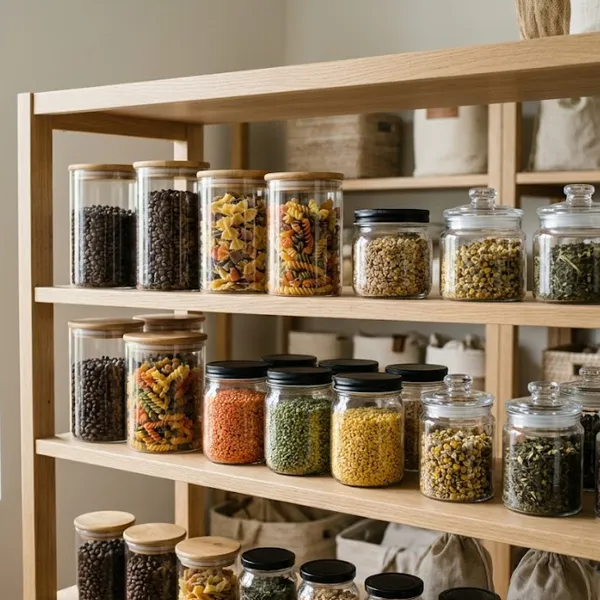 Read More
 -
The Science of Borosilicate Glass Food Containers: Why Thermal Shock Resistance is Key for B2B Procu
July 6, 2026(Key Takeaways)•Borosilicate vs. Soda-Lime: Borosilicate glass offers superior thermal shock resistance and chemical stability com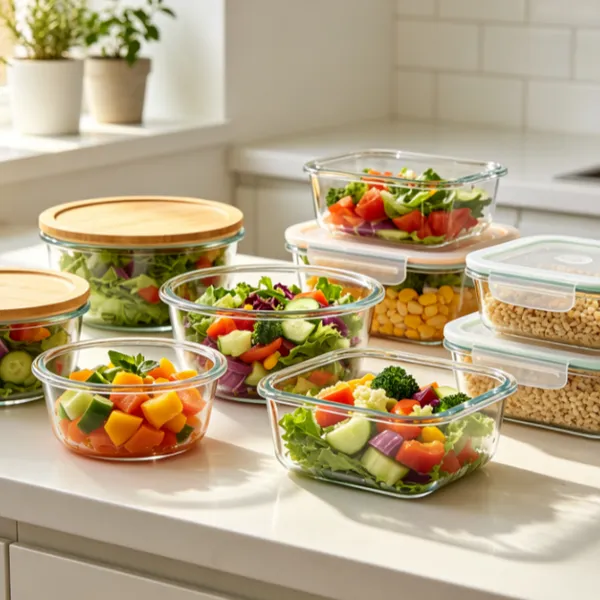 Read More

Contact Us
Recommended Products
-
 Glass Flower Vases Wholesale – Bulk Decorative Vases for Distributors & Importers From KINGSTAR GLASSWAREUS$ 5MOQ: 1000 Pieces
 -
Big Glass Candy JarUS$ 0.4 - 0.8MOQ: 20000 Pieces
-
Big Glass DispenserUS$ 0.4 - 0.8MOQ: 20000 Pieces
-
Good Glass Storage JarUS$ 0.4 - 0.8MOQ: 20000 Pieces
-
Glass Fish BowlUS$ 0.4 - 0.8MOQ: 20000 Pieces